Working Motherhood on a Farm - by Sophie Gregory
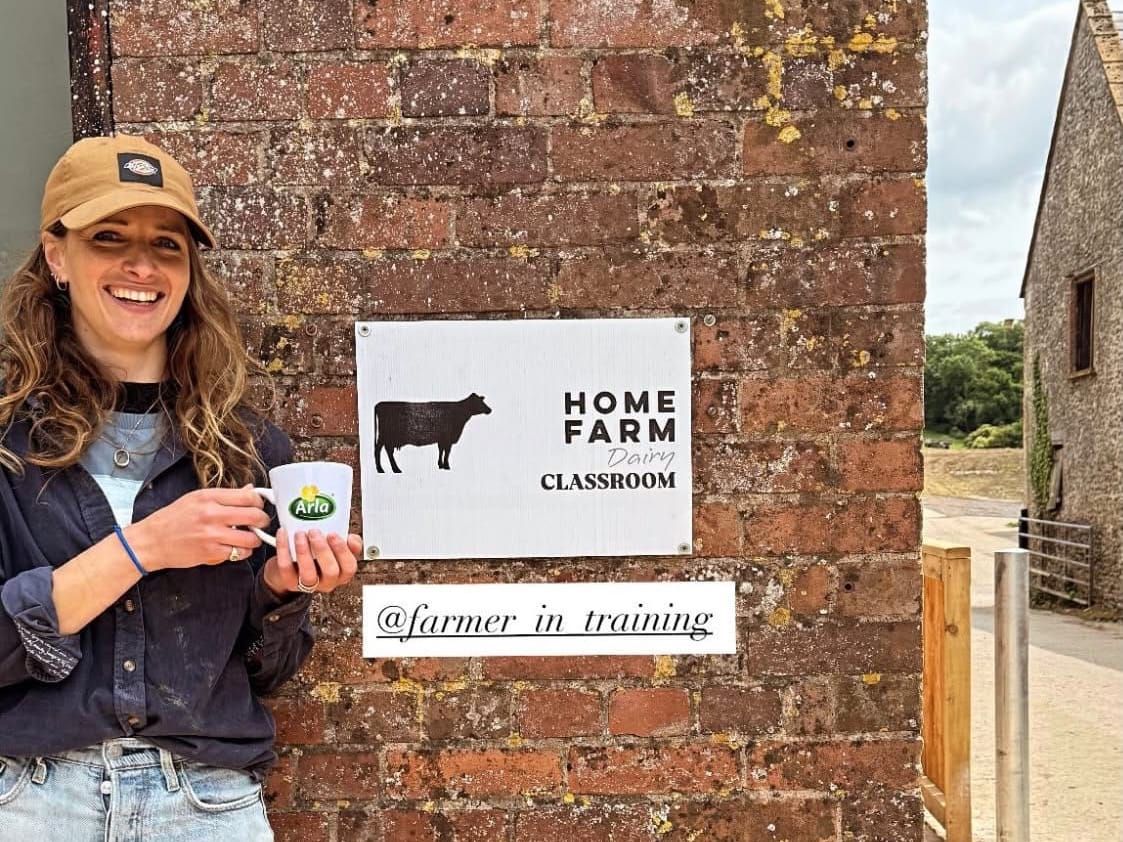
This newsletter is one of a few guest newsletters - so it’s free to read - and the theme is working motherhood which is a topic I love reading and talking about. I want to work and I want to be there for my children and it feels impossible all the time but I'm not giving up!
This newsletter is about someone who works in farming and has done a really good job of carving out a career for herself in a not so typical way (for farming) which is why I asked her to write about it.
I know Sophie through social media. I live on a small working dairy farm but I am not in farming (and I dislike a lot of the cliches that go along with being the partner of a farmer). I take an interest but I see it as Olly's work and I don’t provide any unpaid labour apart from occasionally standing in gateways. I have always naively thought of the cows as his job and that I would have my own job. Naive is an understatement - living on a working dairy farm means that a lot about our family life, and my working life, is dictated by his job and the cows.
There are many bonuses - he is always on the farm somewhere. I am very fond of the cows. He can take the children off on farm jobs. We have a lot of free range space and I think it’s a good thing for the children to be watching both parents work (it feels exhausting but I will look back and realise the benefits).
Anyway - I have an interest in farming and it’s not my life but I like to keep up with parts of the industry I am interested in (might get some sheep one day). I'm interested in Sophie's story because she seems to have carved out a really strong personal brand and a multifaceted career for herself - in farming - but her job is also corporate (she works for a big milk supplier), and educational (she hosts school visits) and she is also a speaker and a podcaster. So she’s in media and public speaking. It is all in and around dairy farming but it’s quite a wide net.
She is also very pragmatic in her approach - it is a business, not a 'way of life'. With her husband Tom, she is running a very ambitious dairy farming operation. With three children, she is clearly working her socks off to make it work. I am really impressed with her tenacity and the opportunities that have obviously come her way because of it. I wanted to ask her about how she has managed to carve this career out of a normally fairly one dimensional and all consuming job (dairy farming) and how she does it as a working mother.
Sophie has managed all of this after having her first child very young, ending up working in farming unexpectedly and tragically losing her mother. She seems to have thrived in the face of some real strife and I am always interested in how being tested emotionally like that can result in impressive outcomes for people.
She’s a bit of an icon in the field she works in but she has a wide reach - she’s talking about farming to people who haven’t got a clue and she has travelled the world talking about her job. So I asked her to write a newsletter about working motherhood; what drives her, what work means to her as well as the practicalities - how she does it. Read it below and follow her on instagram @farmer_in_training
The cows, the children and the work that became mine.
At four in the morning, before the rest of the house wakes up, there is usually tea. It is the quietest part of my day. Before the cows, children, team, WhatsApp messages, school forms, emails and meetings all start competing for the same space in my brain. Starting early is a huge part of how I manage to juggle everything. It is when I am most productive and my head is clearest. I can achieve more in those quiet early hours than I can during the whole evening. After nine at night I am fairly hopeless, so I have stopped pretending I am going to become one of those people who does their best work after the children have gone to bed.
I became a mother at 18, although that was not the plan. I fell pregnant during my gap year and suddenly the path I thought I was on changed completely. Six weeks after Harry was born, I started studying accountancy through the Open University. I did not have a grand career plan. I just knew that I wanted qualifications, financial independence and something that belonged to me as well as being somebody’s mum. I went on to work in a rural accountancy practice, specialising in tax. Farming was not the plan either. I did not grow up on a farm and there was no family business waiting for us.
Tom and I started our dairy farming journey from scratch through a share farming agreement. We slowly built our share in the business, bought out our farming partner and continued to grow. Today, we run two dairy farms with around 600 cows. Writing that in one neat paragraph makes it sound far more organised than it actually was.
There was no perfect plan. There were lots of small decisions, long days, mistakes, brave moments and occasions when we said yes before we had completely worked out how we were going to do it. Work pays the bills. It gives our family choices and helps us build something for the future. I would be lying if I pretended money did not matter. It does.
But work is also a huge part of my identity.
I love being a mum, but I have never wanted motherhood to be the only thing that defines me. I am curious. I like learning, meeting people, travelling and being involved in conversations that might make farming a little better. My work now stretches far beyond milking cows. Some days I am checking grass, looking at figures or talking through jobs with the farm team. Other days I am hosting schoolchildren in our farm classroom, recording a podcast, attending an industry meeting or speaking about dairy farming somewhere completely different from home.
From the outside, that can look like a carefully created career or personal brand. The truth is that I never sat down and decided to build a brand. I started sharing our farming story because I wanted people to understand where milk came from and what actually happened behind the farm gate. One opportunity led to another. Social media led to conversations, conversations led to meetings, and meetings led to roles, travel, speaking and podcasting. I kept following the things that interested me and tried to do a good job when somebody trusted me with an opportunity.
How do I actually do it?
The honest answer is that I do not do it alone. There is no version of my life where I am effortlessly running two farms, raising three children, travelling, recording podcasts and remembering every school event without help. We have a team on the farms. Tom and I share responsibilities. Our children are older now and increasingly independent. I lean on family, friends, school, childcare and the people around us.
I ask for help. Sometimes later than I should, but I am getting better at it.
There are also some very unglamorous practical systems holding our life together: Tom and I have a shared diary because if something is not in the diary, it does not exist. I do the food shop online, we have a veg box delivered and there is usually a freezer full of meat. I use AI to create our weekly meal plan from what we already have. It saves me from standing in front of the fridge at six in the evening hoping a family meal will reveal itself.
I use the tumble dryer more than I would like to admit. Sometimes getting everybody into clean clothes simply has to win. My vice is a really cold, full fat Coca Cola. Not every day, but on the days when only a cold Coke will do, nothing else will do. I do not drink alcohol because I am an all or nothing kind of girl and moderation has never really been my strongest quality.
None of these things is revolutionary, but together they remove hundreds of small decisions from an already full head. Working motherhood is often discussed as if there is a perfect system waiting to be discovered. I have not found it. There is no shared diary capable of making a cow calve at a convenient time or stopping a child from needing you five minutes before an important call.
Our life moves in seasons. During calving, the farm needs more of us. During school holidays, the children are everywhere. Some weeks work wins. Some weeks family wins. Some weeks nobody wins and we simply get to Friday with everyone fed. I no longer aim for perfect balance every day. I look for balance over a longer period.
Bringing up my children without my mum has to be one of the hardest things I have ever done. I lost her at the point in my life when I needed her most. There have been so many moments when I have wanted to ask her a question, tell her something funny or have her reassure me that I am doing an okay job.
There are practical things I have missed, but it is the emotional gap that is the hardest. Sometimes you do not need advice. You simply need your mum. No amount of organisation, childcare or support can completely fill that space.
Grief does not sit separately from motherhood. It turns up at school events, birthdays, difficult days and the moments when you look at your children and wish she could see the people they are becoming. It has also made me appreciate the people who do turn up for us. It has taught me to build a village, accept help and be honest when things feel heavy.
Of course I feel guilty.
I feel guilty when I am working and think I should be with the children. Then I feel guilty when I am with the children and know there are jobs waiting.
Working from home or on the family farm creates another strange layer. You are physically nearby, but that does not always mean you are available. The children can see you, the cows can see you and everybody assumes you can probably squeeze in one more thing. I have missed things. I have forgotten forms. I have arrived late. I have answered emails from car parks and served cereal when I could not face cooking.
But our children also see both of us work hard to build something. They see that opportunities do not simply arrive. They are created through effort, relationships and sometimes doing things when you feel completely out of your depth.
I hope they grow up knowing that loving your family and having ambition are not opposites. The children may want to farm one day, or they may choose something entirely different. Our job is to build a business that gives them opportunities, not obligations.
For years, I thought resilience meant carrying on regardless. Now I think it means recognising when something is too heavy to carry alone. Farming teaches you to keep moving. Cows still need milking when you are tired, worried or having a bad day. That routine can be grounding, but it can also make it easy to keep pushing without admitting that you are struggling.
The most useful thing I have learned is to talk. To tell someone when life feels heavy. To ask for help and let people help. Sometimes resilience is not a huge inspirational moment. It is a cup of tea, a walk with the dog, an honest conversation and getting up again tomorrow.
I want to build a strong business, but I also want a full and interesting life.
I want our farms to provide good jobs and opportunities for other people. I want children to visit and leave understanding a little more about farming and food. I want young women to see that agriculture can offer them a huge range of careers. I also want to travel, learn from farmers around the world and bring those ideas home.
Farming might look like a narrow job from the outside, but it has opened doors into business, education, communication and international work. The cows remain at the centre of it all. They are the reason the business exists and they have absolutely no interest in whether I have an important meeting, a podcast recording or a train to catch.
There is something wonderfully grounding about that.
I still do not have everything worked out. I am still juggling, regularly dropping balls and drinking a lot of tea. But I am proud of what we have built from scratch. I am proud that our children have grown up watching both parents work.
Most of all, I am proud that somewhere inside an all consuming job, I managed to create a career that feels like mine.
Sophie Gregory
@farmer_in_training